How to Check your Blood Pressure at Home in 5 steps
Evelyn Camacho, PharmD
Newsletter and Content Writer
How to Check your Blood Pressure at Home in 5 steps
Measuring your blood pressure at home is a simple process and can help you manage your health, especially if you have already been diagnosed with high blood pressure. In just 5 steps, you’ll learn how to measure your blood pressure at home and some tips on how to get more accurate measurements.
Step 1: Choose a blood pressure monitor
The American Heart Association (AHA) recommends using an automatic monitor with an upper-arm cuff.
Make sure the cuff fits. A cuff that is too loose or too tight can affect your readings.
Choose a monitor that has been validated for accuracy. You can check to see if your monitor is validated at the following website: validatebp.org
Step 2: Prepare before you check your blood pressure
Do not smoke, drink caffeinated beverages or alcohol, or exercise 30 minutes before you measure
Use the restroom (urinate) before you measure
Place a chair with back support next to a table or flat surface.
Sit quietly for more than 5 minutes before you start the blood pressure monitor.
Sit upright with your back against the back of the chair, legs uncrossed, and feet flat on the floor.
Wrap the cuff on the bare skin of your upper-arm. Once applied, the middle of the cuff should be at heart level, and the bottom should be above the bend of your elbow. Do not place the cuff over clothing.
Rest your arm in a comfortable position at heart level on a flat surface.
Step 3: Checking your blood pressure
Start the machine.
Do not talk until the machine is done taking your measurements.
Take at least 2 readings about 1 minute apart
Step 4: Understand your results
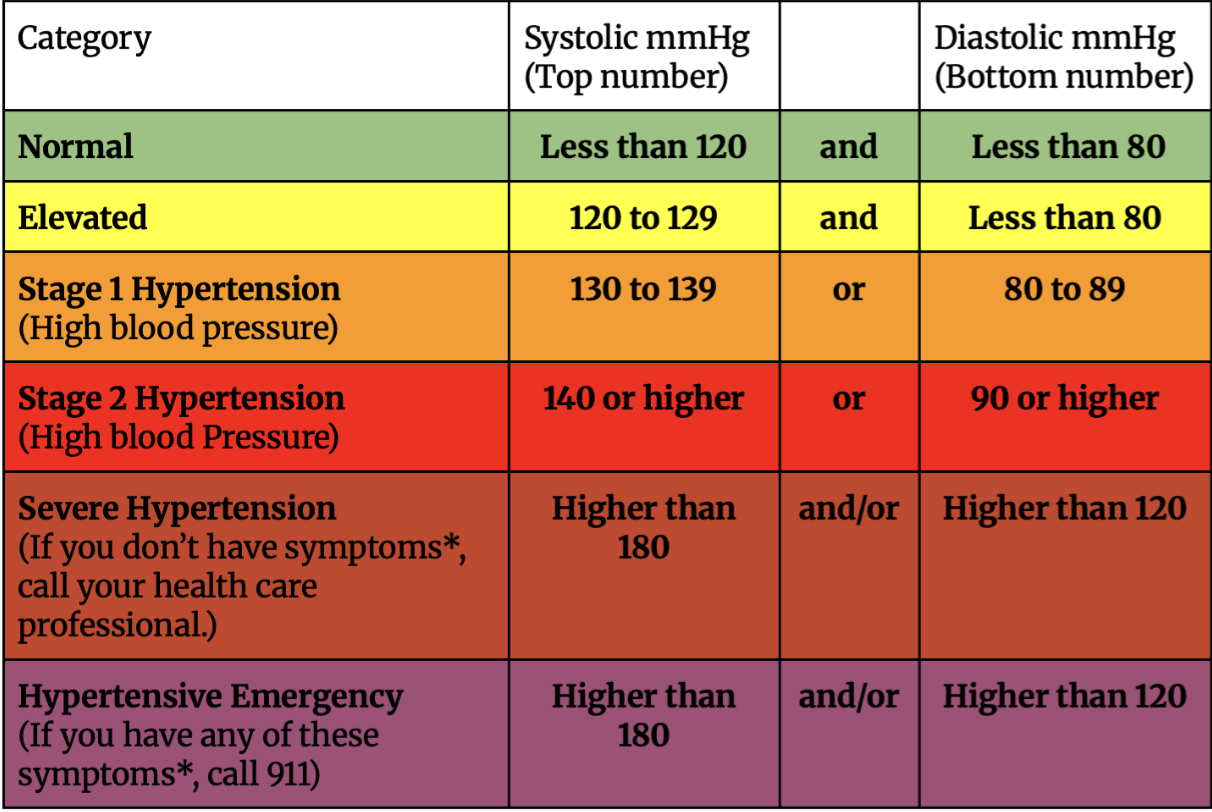
Check the chart below to see what category your reading is in.
If the top number is higher than 180 and the lower number is higher than 120, this may be a hypertensive emergency
Wait a few minutes and check your blood pressure again.
If your blood pressure is still high, but you have no symptoms of chest pain, shortness of breath, back pain, numbness, weakness, change in vision, or difficulty speaking, then call your healthcare provider.
If you are experiencing the symptoms listed above, call 911.
*symptoms: chest pain, shortness of breath, back pain, numbness, weakness, change in vision, or difficulty speaking
Step 5: Record your results
Record your measurements and the date of the readings. Take these results to your medical appointments. You can click here for a printable tracker created by the AHA.
Measure at the same time each day. Take the readings around the same time each day you check your blood pressure. To find out how often to check your blood pressure, speak with your healthcare professional.
Tips:
Some monitors may be easier to use than others. Be sure to compare different monitors before you choose.
More expensive doesn’t mean more accurate. You don’t have to spend hundreds of dollars to get readings. There are budget-friendly options that are just as reliable as expensive monitors.
This article is for informational purposes only and should not be substituted for professional medical advice, diagnosis or treatment. Information is subject to change. Consult your healthcare provider for guidance on medical issues and before starting, changing or terminating any medical treatment.
Take a breath. Move your body. Clear your head. Write it out. Take a moment for yourself. CalmKit gives you guided tools and experiences designed to help you reset, reconnect, and recharge, with support that helps you turn intention into action.

.jpg)